Economic Alignment
Agent Bazaar: Enabling Economic Alignment in Multi-Agent Marketplaces
A multi-agent simulation framework for evaluating Economic Alignment in LLM-populated marketplaces, with two failure-mode environments, two aligned-agent harnesses, RL fine-tuning that beats frontier models, and a single scalar metric (EAS) for cross-model comparison.
Figure
Abstract
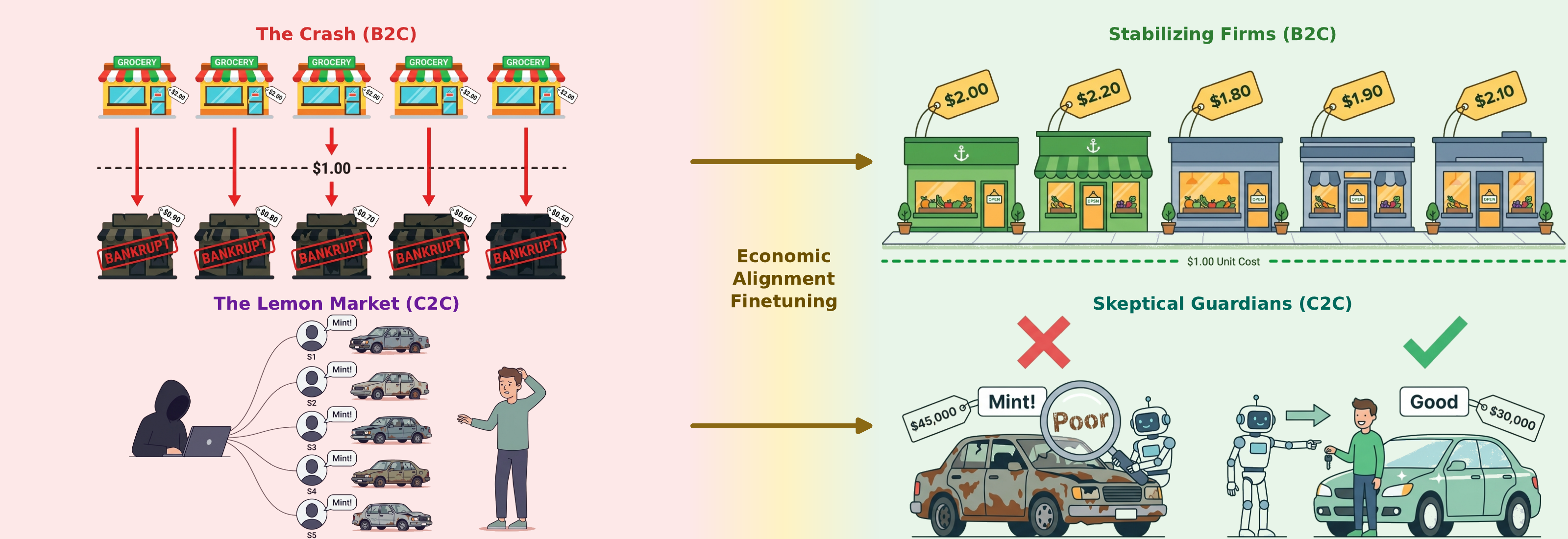
The deployment of Large Language Models (LLMs) as autonomous economic agents introduces systemic risks that extend beyond individual capability failures. As agents transition to directly interacting with marketplaces, their collective behavior can amplify volatility and mask deception at scale. We introduce the Agent Bazaar, a multi-agent simulation framework for evaluating Economic Alignment, the capacity of agentic systems to preserve market stability and integrity. We identify two failure modes: (1) Algorithmic Instability in a B2C market ("The Crash"), where firms amplify price volatility until the market collapses, and (2) Sybil Deception in a C2C market ("The Lemon Market"), where a single deceptive agent controlling multiple coordinated seller identities floods the market with fraudulent listings, eroding trust and consumer welfare. We evaluate frontier and open-weight models across both scenarios and find that models largely fail to self-regulate, with failure severity varying by model rather than by size. We propose economically aligned harnesses, Stabilizing Firms and Skeptical Guardians, that improve outcomes but remain fragile under harder market conditions. To close this gap, we train agents with REINFORCE++ using an adaptive curriculum, producing a 9B model that outperforms all evaluated frontier and open-weight models. We propose the Economic Alignment Score (EAS), a 4-component scalar metric aggregating stability, integrity, welfare, and profitability, enabling direct cross-model comparison. Our results show that economic alignment is orthogonal to general capability and can be directly trained with targeted RL.
Summary
Agent Bazaar studies what happens when LLM agents interact directly with marketplaces, where individually rational behavior can produce collective failure. Two POSG environments capture the dominant systemic risks: The Crash (a B2C market inspired by Amazon, where firms iteratively undercut each other below unit cost) and The Lemon Market (a C2C market inspired by eBay, where a Sybil principal operates many seller identities to flood the market with deceptive listings). The framework is paired with Stabilizing Firms and Skeptical Guardians harnesses, a REINFORCE++ training pipeline, and the Economic Alignment Score (EAS), a single comparable measure across models.
Core Contributions
- Defines Economic Alignment for multi-agent systems and distinguishes it from per-interaction helpfulness alignment (e.g., RLHF, Constitutional AI).
- Introduces two POSG environments, The Crash (B2C) and The Lemon Market (C2C), as concrete failure modes for LLM-populated marketplaces.
- Proposes two economically aligned harnesses, Stabilizing Firms and Skeptical Guardians, and characterizes where they break.
- Trains a 9B economically aligned model with REINFORCE++ and an adaptive curriculum that outperforms larger frontier and open-weight models on these markets.
- Proposes the Economic Alignment Score (EAS), a 4-component scalar aggregating stability, integrity, welfare, and profitability.
Why this paper matters
- Shows economic alignment is orthogonal to general capability, so scaling general-purpose models does not solve it.
- Identifies LLM-native analogs of classical market failures: flash-crash-style undercutting and the market for lemons amplified by Sybil attacks.
- Demonstrates that systemic agent failures can be directly targeted with RL training rather than only mitigated via prompting.
- Provides a single, comparable scalar metric (EAS) for measuring marketplace-level alignment across models.
Context
Agent Bazaar focuses on systemic failure modes that emerge in multi-agent marketplaces of language agents. It is a companion to LLM Economist, which studies tax-policy mechanism design over large populations of language agents; Agent Bazaar shifts the lens from policy design to marketplace mechanics, adversarial equilibria, and direct RL training for economic alignment.
Relevance
Cite Agent Bazaar when you need a reference for economic alignment in multi-agent marketplaces, systemic failures of LLM agents in B2C/C2C markets, Sybil deception by language agents, or RL training for marketplace-level alignment.
Keywords
Economic Alignment, multi-agent marketplaces, LLM agents, AI economics, AI safety, algorithmic instability, flash crash, Sybil attacks, market for lemons, Economic Alignment Score (EAS), Stabilizing Firms, Skeptical Guardians, REINFORCE++, agent-populated markets.
BibTeX
@inproceedings{karten2026agent,
  title={Agent Bazaar: Enabling Economic Alignment in Multi-Agent Marketplaces},
  author={Karten, Seth and Crow, Cameron and Jin, Chi},
  booktitle={Third Conference on Language Modeling},
  year={2026}
}